
By Paulius Petravicius
On an earlier, fictional Spotter finance-system upgrade, a new guide edition prompted a template overhaul. Meetings acquired new names. Reports acquired new headings. The unresolved supplier questions stayed unresolved. With the PMBOK 8th edition, the useful question is smaller: which published changes should affect a working PM’s decisions, records or conversations next week?
A new edition changes the book. Change your project arrangements when there is a practical reason, with the right authority.
I haven’t sat a PMI exam, and I read a new PMBOK edition the same way I read any guidance: what does it change in the decisions, records and conversations on my projects next week? Most of the time the answer is a sharper question, not a new template.
Education note: This is a practitioner’s reading of PMI’s published changes, not a book review or exam guidance. Facts about the Eighth Edition come from PMI’s product page, table of contents and errata; the “what it means” notes are InsightSpotter’s view. Check the Guide itself before relying on a detail.
For the distinction between guidance to tailor and a project method, see PRINCE2 7 vs PMBOK 8.
PMBOK 8th edition at a glance
- Published in November 2025, the 408-page publication is classified as a PMI Standard and includes The Standard for Project Management. PMI overview; contents PDF.
- It has six principles and seven performance domains. PMI overview.
- Process Groups return as five Focus Areas. Kelly Heuer’s PMI presentation counts 40 evolved processes alongside them. PMI contents PDF; Heuer’s PMI presentation hosted by NTT DATA.
- PMI highlights expanded coverage of AI, PMOs and procurement. PMI overview.
- PMI also provides second-printing errata, listed as last updated in April 2026. PMI overview; errata PDF.
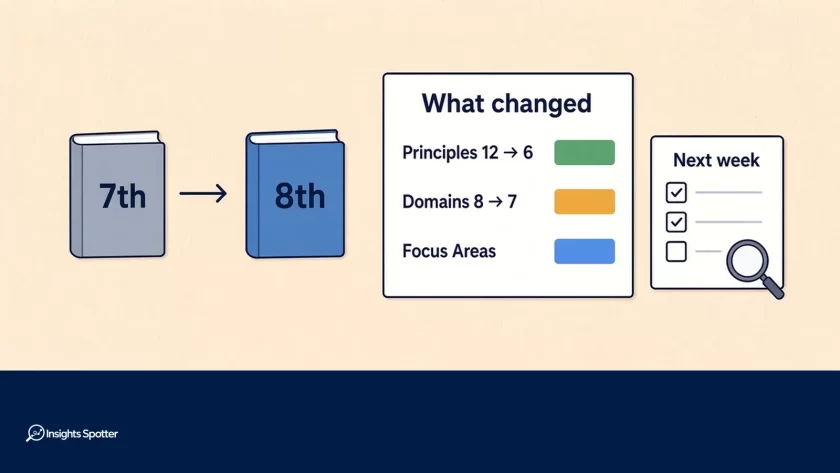
What changed from the 7th edition
Education note: InsightSpotter summary built from PMI’s published table of contents, product page and 7th-edition materials; the “what it means” column is our practitioner reading, not PMI guidance. The public sources checked here do not supply an official domain crosswalk; this table does not map old domains to new ones.
| What changed (7th → 8th) | Source | What it means on Monday |
|---|---|---|
| Principles: 12 → 6; titles include Be an Accountable Leader and Integrate Sustainability Within All Project Areas. | 7th principles; 8th contents | Turn principles into review questions; record who authorised a decision. |
| Domains: eight → seven. The 7th included Team, Planning, Project Work, Delivery, Measurement and Uncertainty; the 8th names Governance, Scope, Schedule, Finance, Stakeholders, Resources, Risk. | 7th domains; PMI overview | Use familiar management concerns to find gaps in a sponsor conversation. |
| Governance becomes a dedicated domain. | Heuer, PMI presentation hosted by NTT DATA | Check delegated limits and escalation routes. |
| Finance is a named domain; Heuer describes its scope as wider than project costs. | PMI overview; Heuer presentation | Review forecasts and value alongside expenditure. |
| 7th referenced Process Groups without fully including them; 8th reintroduces them as five Focus Areas; Heuer counts 40 evolved processes. | 7th FAQ; 8th contents; Heuer presentation | Check the work being managed before rebuilding a process manual. |
| Tailoring remains: approach selection → organisation → project → ongoing improvement; Diagnostics is included. | 7th FAQ; 8th contents | Record why the chosen controls suit this project. |
| 7th had Models, Methods, and Artifacts; 8th lists Inputs and Outputs and Tools and Techniques, with no section bearing the earlier title. | 7th FAQ; 8th contents | Use the reference material for a need; headings do not establish that earlier content was deleted. |
| Expanded PMO, AI and procurement coverage includes dedicated appendices. | PMI overview; 8th contents | Review PMO usefulness, AI-use rules and supplier obligations. |
| 8th has second-printing corrections, including two metric formulas. | PMI errata | Check the printing before copying calculations. |
On a phone, swipe the table sideways to see all three columns.
What it means for day-to-day project work
Governance: make authority findable
Take the governance change as a prompt to inspect a recent approval. Can someone find who decided, the limits of their authority, the reason and any conditions? Use the decision log to preserve that answer. Check tolerances and escalation where delegated limits are unclear. Renaming a board pack cannot give its chair extra authority. A useful improvement might be one missing condition recorded against an existing decision, with a clear reference back to the evidence.
Finance: ask what the forecast buys
The practitioner question is whether the next expenditure still supports the intended result. A project can spend within budget while its expected value weakens. Put the latest forecast beside the remaining work and the assumptions behind the benefit, and check that the benefits realisation plan still names an owner and a baseline. Ask the sponsor what would change their willingness to continue. For a BA moving into project management, this connects familiar requirements questions to the consequences of funding a particular delivery choice. It does not require another finance dashboard.
Focus Areas: check evidence in the work
The five names are Initiating, Planning, Executing, Monitoring and Controlling, and Closing. PMI contents PDF. In a PMI presentation hosted by NTT DATA, Dr Kelly Heuer, PMI’s Vice President of Learning, explains that Focus Area actions may use formal processes or informal management efforts, and that not every process applies to every project. Heuer presentation, January 2026. Read that as permission to examine the management need without treating the names as sequential delivery phases. For Monitoring and Controlling, use a project health check to ask what evidence supports the forecast. An existing review can do that job.
Tailoring: give each consequence a home
PMI emphasises adapting practices to context. PMI overview. In InsightSpotter’s working model, the RAID log is the one list for risks and issues, with assumptions and dependencies alongside when relevant. Keep a separate decision log and a separate action log on every project; both are required. A separate risk register is rare, used for a PMO, audit, regulator or programme requirement. See RAID log vs risk register.
Education note: That records model is InsightSpotter’s tailoring choice, not a PMI requirement or a claim about the contents of its Inputs and Outputs chapter. A domain describes an area of practice; its name alone is no reason to create another register. Write down the agreed arrangement once so the team knows which record to update.
Appendices and reference chapters: follow a real need
For the PMO, ask what service would help the delivery team make a better decision this week. For AI, establish which tools and data uses the organisation permits before sharing project information. For procurement, check the relevant contract, approval route and any unresolved claim with the supplier liaison. These are editorial prompts for applying the expanded coverage, not a summary of appendix instructions. Heuer’s PMI presentation hosted by NTT DATA describes inputs, tools and outputs as illustrative rather than exhaustive or prescriptive. Heuer presentation.
Errata: check before copying
The errata corrects the start-to-finish explanation as well as the two formulas. PMI errata PDF. Before copying a calculation into a template, check the printing on the copyright page against the corrections. Then establish whether the calculation answers a useful project question. Correct arithmetic still needs an agreed meaning, a source for the data and someone who knows what to do when the result changes.
What didn’t change
The Guide remains something to tailor; PMI continues to cover predictive, adaptive and hybrid approaches. PMI overview; contents PDF. Your organisation’s governance and delegated authority still govern local choices. An edition change does not authorise a new spending limit or replace your RAID, decision and action logs. Keep the arrangements that work, and make any revision answer a specific need.
Spotter: “Do we need to change everything?”
Spotter, Sam, Ruth, Priya and the team are fictional teaching characters, not a real project or client.
On Wednesday 11 November 2026, Ruth, sponsor and board chair of the booking-service trial, asks Priya, the PMO lead: “PMBOK 8 has been out for a year — do we need to change how the trial is run before go-live?” Priya and Sam, the PM, spend 30 minutes with the change table.
Sam records D-015 in the decision log: Ruth, acting within her delegated authority, approves retaining the trial’s delivery approach before the staff-only go-live on 9 December. The review identifies no reason to replace the current controls; a template overhaul this close to launch would add disruption. Existing acceptance conditions still apply.
The AI prompt does uncover something worth checking. The team has started using an AI tool for summaries of non-confidential minutes. The next board pack includes supplier commercial details, and approval for that use has not been established.
R-022 goes into RAID, owned by Maya: if confidential details enter a tool without confirmed approval, supplier information could be exposed. No disclosure is asserted. Maya’s next risk review is 13 November. The team holds back confidential material pending confirmation.
A-042 goes into the action log: Priya confirms the organisation’s AI-use rule with IT/security by 12 November, with the permitted tool and data boundaries recorded as completion evidence. A-043, also Priya’s, is due 15 January 2027: review PMO templates after go-live against the change table and record recommendations. Both actions remain open on 11 November.
The review leaves one decision, one risk and two follow-ups in their proper homes. It gives the team a concrete improvement without interrupting the trial with a vocabulary exercise.
Before you update your templates
- Read PMI’s summary of changes in the Guide before proposing an overhaul; use the public sources here to orient the review.
- List the decisions, records and conversations each proposed change would affect; leave meeting names alone where their purpose is already clear.
- Keep one RAID working list, plus a separate decision log and a separate action log on every project.
- Write tailoring choices down once, including any governance requirement for a separate risk register.
- Check your printing and the errata before reusing a definition or formula.
- Establish AI-use rules for the team’s tools and information.
- Log an authorised decision before changing templates mid-stage, with a reason and an implementation date.
If you’re comparing PRINCE2 and PMBOK, use the separate PRINCE2 7 vs PMBOK 8 article.
If you’re studying for an exam, see the separate Business Analyst to Project Manager skills and learning path.
Pick the change that exposes a real gap, give its consequence an owner and a record, and review whether the response helped. For more practical project conversations, join the InsightSpotter newsletter.