
By Paulius Petravicius
The Spotter partner-onboarding platform passed its project health check with 82 out of 100. The PMO had asked 60 yes/no questions. Most answers confirmed that a template existed. Nobody owned data migration, and no cut-over decision was recorded. Those two zeros disappeared inside the total. Two months later, in October 2026, cut-over slipped. Everyone had the report. Nobody had an action.
Fiction label: Spotter, Sam, Priya and the team are fictional teaching characters, not a real project or client. The scores are teaching values, not benchmarks. The partner-onboarding platform is a separate failure case.
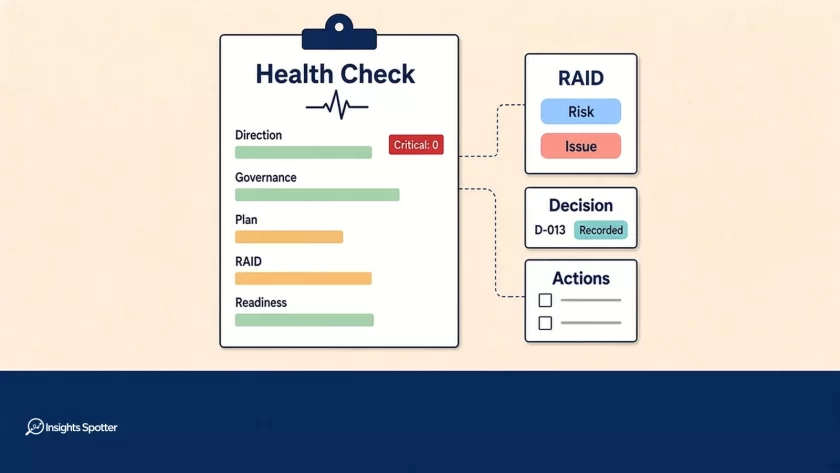
A project health check asks for evidence, not reassurance; critical gaps cannot be averaged away; every finding gets one home in the RAID, decision or action log.
When I run a health check, a confident answer is not evidence. I ask to see the record behind it. Every finding goes into the RAID log, the decision log or the action log, or it hasn’t really been dealt with.
Education note: The 25 questions, the five areas, the 0–2 scale and the critical-question rule in this article are InsightSpotter editorial choices for teaching, not a standard. PMI, APM and NISTA material describes health checks and assurance reviews, but none of it prescribes this question set or this scoring. Adapt the questions and weights to your organisation.
What a project health check is (and isn’t)
A health check is a periodic, evidence-based look at how a project is being run and whether its outlook is credible. Choose someone with enough distance to challenge assumptions: a peer, PMO reviewer, sponsor or external practitioner. Eddie Merla describes that brief, outside perspective in his 2005 PMI conference paper; Reuben Levett’s 2012 PM Network article connects it with sponsor and PM confidence in the project’s position.
| Review | Main question | Output |
|---|---|---|
| Health check | Is the project being run credibly? | Evidence profile; findings; follow-ups |
| RAG status | What is delivery status this cycle? | Colour against agreed criteria |
| NISTA Gate Review | Can this major project progress? | Independent assessment at a decision point |
The NISTA assurance toolkit covers formal independent reviews, mainly for complex, high-risk government projects. Its Gate Review guidance also makes clear that a review does not replace a full audit opinion on risk management, control and governance. This half-day check provides neither that formal review nor an audit opinion.
Weekly delivery colour belongs to the RAG status criteria and RAG calculator. It comes from those criteria, never from this health-check total.
When to run one
- Before a stage boundary or go/no-go, while findings can still affect the choice.
- When the sponsor asks how the project is really doing, or a stakeholder requests a review, as Merla suggests.
- After a re-plan or exception; use the tolerances guide to check authority.
- On longer projects, agree a review rhythm: Neal Whitten’s 1999 article suggests every three to four months for projects lasting over six months. That is his suggestion, not a rule.
The 25 project health check questions
InsightSpotter teaching template; adapt to your context. C marks a critical question. This version has five, including operational readiness near go-live. Agree that flag before reviewing evidence; earlier in delivery, assess the readiness plan appropriate to the next release.
On a phone, swipe each question table sideways to see all four columns.
A Direction & benefits
| Q# | Question | Evidence to ask for | Critical |
|---|---|---|---|
| A1 | Are objectives and success criteria agreed? | Approved objectives; measurable success criteria | — |
| A2 | Does the current justification still support the work? | Business case review; benefits and cost assumptions | — |
| A3 | Is someone named to own benefits after project close? | Accepted benefits ownership; measurement and handover plan | C |
| A4 | Is scope controlled against an agreed baseline? | Scope baseline or agreed backlog; CR- approval trail | — |
| A5 | Are stakeholder expectations recorded and checked? | Stakeholder agreements; recent feedback and responses | — |
B Governance & decisions
| Q# | Question | Evidence to ask for | Critical |
|---|---|---|---|
| B1 | Are sponsor and board authority clear? | Named sponsor; terms of reference; delegated authority | — |
| B2 | Is the decision log current, with authority and conditions? See decision log. | Last three decisions; approval evidence; condition checks | C |
| B3 | Are decisions taken within the right authority? | Recent choices matched to delegation and tolerance holders; tolerances | — |
| B4 | Were forecast exceptions escalated to the right level? | Forecast history; Exception Report; board response; Highlight and Exception Reports | — |
| B5 | Does the board put decisions before updates? | Recent agenda; decision papers; recorded outcomes; SteerCo agenda | — |
C Plan, forecast & control
| Q# | Question | Evidence to ask for | Critical |
|---|---|---|---|
| C1 | Are the plan and forecast current and owned? | Dated integrated plan or release forecast; named owner | — |
| C2 | Are tolerances written down with named holders? | Approved tolerance sheet; holders and escalation routes | — |
| C3 | Does the cost forecast cover remaining work? | Budget; actuals; commitments; estimate to complete | — |
| C4 | Are the critical path and dependencies visible? | Linked milestones or flow dependencies; external commitments | — |
| C5 | Does the status report agree with the records? | Latest report checked against dated source records | — |
D RAID & actions
| Q# | Question | Evidence to ask for | Critical |
|---|---|---|---|
| D1 | Is one RAID list current, with owners and review dates? | Working RAID list; recent reviews; linked decisions and actions; RAID template | C |
| D2 | Do current issues have owners and target dates? | Open issue rows; impact; resolution dates and evidence | — |
| D3 | Is the action log current, with owners, dates and overdue items visible? | Recent action rows; due dates; closure evidence; overdue view | C |
| D4 | Are material assumptions and dependencies being tested? | RAID assumption checks; dependency confirmations and dates | — |
| D5 | Is any separate risk register justified by governance? | Governance requirement or confirmation RAID is the risk record | — |
E People, supplier & readiness
| Q# | Question | Evidence to ask for | Critical |
|---|---|---|---|
| E1 | Are the skills and capacity for the next work available? | Capacity commitments; skills gaps; cover arrangements | — |
| E2 | Are supplier commitments written down and tracked? | Written dates; acceptance commitments; exit or rollback test booking | — |
| E3 | Are quality and acceptance criteria agreed and evidenced? | REQ- traceability; test results; definition of done for increments | — |
| E4 | Is operational readiness evidenced for the next release? | Training dates; agreed support rota; handover and readiness checks | C |
| E5 | Have relevant lessons changed how the team works? | Earlier lessons linked to changed practice and results | — |
If the status report and the records disagree, see the watermelon reporting guide.
The table checks three separate records: one working RAID list, a decision log and an action log. The decision log and the action log are both required on every project, and kept separately from RAID. A separate risk register is rare and only for governance: PMO, programme, audit or regulator requirements. The RAID versus risk register guide explains how to avoid duplicating the working risk record.
For iterative delivery, bring the agreed backlog, release forecast, recent increments and definition of done. Ask whether they demonstrate control and acceptance. A large document is unnecessary when a short, accessible record answers the question. Equally, an active board cannot prove that someone has accepted ownership of benefits after the team disperses.
How to score it without fooling yourself
- 0: No evidence, or the evidence contradicts the answer.
- 1: Evidence exists but is stale, partial or not used.
- 2: Current evidence has been seen and used.
- N/A: Allowed only with a written reason. Remove two points from the maximum for each excluded question.
Start with equal weights and a maximum of 50. Show five area sub-scores out of 10, adjusted for justified exclusions, followed by the critical zeros. If one question is N/A, its area maximum becomes eight and the overall maximum becomes 48. An unanswered question remains unassessed until checked; do not turn a blank into zero or quietly exclude it.
Any critical question scored zero is a headline finding, whatever the total. A current plan cannot compensate for an absent benefits owner. A critical question that scores one still needs a follow-up; it just does not trigger the headline rule. Keep the factual consequence visible alongside the number so the sponsor can judge urgency.
The APM Assurance SIG’s 2012 whitepaper represents the group’s thinking, not necessarily APM’s views. It prioritises documentary evidence and lowers scores where documentation is missing. Its different method scores ten criteria from 0–10, yet one red criterion makes the overall assessment red even above 90/100. Excluded criteria reduce its maximum. That illustrates why a total can conceal a gap; this article borrows the caution, not its colour system.
The same whitepaper warns that self-assessments tend to be generous. Use them to prepare, then bring a second pair of eyes. It also cautions that a high rating cannot guarantee success. These teaching scores provide no prediction of success or failure.
Education note: The 0–2 scale, critical flags and area profile are InsightSpotter choices. NISTA’s Guide to preparing an Assurance Review Report allows informal scoring during deliberations but says “the SGA is not a calculation”. The APM SIG toolkit uses a different scale. Scores organise the conversation; people make the judgement.
Record what was seen and when. “Plan reviewed” is weak evidence. “Release forecast dated 6 November, owned by Sam, used to sequence acceptance work” explains the judgement. Where evidence conflicts, record the contradiction and ask the owner to resolve it. A polished explanation alone should not raise the score.
How to run it in half a day
For a small project with accessible records, reserve four hours of reviewer time. This is an editorial timebox, not a promise or assurance standard. Arrange access and interviews beforehand. Larger, troubled or specialist projects need a deeper review; record the limits of a short check rather than claiming full coverage.
- 20 minutes: agree scope and audience. Sponsor and PM agree the question set, critical flags, evidence cut-off and who receives findings. Name exclusions and the next decision the check should inform.
- 60 minutes: read the records first. Review RAID, decision log, action log, plan and forecast, tolerance sheet, business case and relevant acceptance evidence. Follow links between the three logs.
- 60 minutes: interview briefly. Ask the PM and relevant owners open questions: what changed, what could invalidate the forecast, and which record demonstrates the answer? Allow time for contradictions.
- 40 minutes: score and explain. Capture evidence references, area scores, critical zeros and factual findings. Separate an observed gap from its possible consequence.
- 30 minutes: read back. Show the PM first, correct factual errors, then review with the sponsor. Preserve disagreements and the evidence needed to resolve them.
- 30 minutes: agree follow-ups. Put entries in the existing logs, confirm owners and dates, and set the next check. Implementation continues beyond these four hours.
This sequence adapts Levett’s assessment, reporting and support pattern; it is not a mandated process. His reporting advice is to prevent surprises for sponsor and PM. Whitten also gives the PM first sight of findings so errors can be corrected before wider circulation. First sight allows correction, not a veto over an uncomfortable finding.
Sarah Coleman’s 2023 APM blog suggests introducing assurance as a health check or critical friend review, with depth matched to context. Her point about recommendations requiring action matters here: challenge should help the team change something. Ask what support the owner needs, including sponsor authority or capacity, rather than merely assigning another deadline.
From findings to actions
Give each finding one authoritative home. A risk and its mitigation task are different items, so they can have linked rows in different logs. Cross-references preserve the chain without creating two editable versions of the same finding. The completed review sheet is a dated evidence snapshot, not a second follow-up tracker.
| Finding type | Where it goes | Example ID |
|---|---|---|
| Uncertain future harm | RAID: risk | R-020 |
| Problem already present | RAID: issue | I-015 |
| Choice needing authority | Decision paper, then decision log after approval | D-013 |
| Dated follow-up | Action log | A-036 / A-037 |
A decision request is not an approved decision. Prepare the choice and evidence for Ruth; add the D- entry only when the authorised outcome is agreed. The decision-log guide explains that boundary. Keep action ownership and completion evidence in the action log, with the RAID or decision ID as the reference.
Whitten says review problems should become action items followed through to closure. In this model, the underlying risk or issue remains in RAID while its follow-ups live in the action log. At the next health check, start with those entries. Closing a task proves its completion condition; it does not automatically resolve the underlying issue or remove the risk.
Worked example: Priya checks Sam’s trial on 6 November 2026
Fictional teaching example. Priya, the PMO lead, agrees scope with Ruth, sponsor and board chair, and Sam, the PM. On Friday 6 November she reads the records, then interviews Sam, Noor, the issue owner, and Alex, supplier liaison. Maya remains the risk owner. The review precedes the planned 9 December staff-only go-live.
D-009, approved on 30 October, superseded D-004. D-011, agreed on 2 November, conditionally accepted a 26 November stage finish while retaining the 9 December commitment, must-haves and quality gates. Priya sees Alex’s written rework dates against A-031, completed by 4 November, and Noor’s acceptance-window evidence against A-032, completed by 5 November, including technical-lead confirmation that REQ-017 remains protected. That supports D-011’s condition; it does not prove every release gate has passed or close I-012.
She also finds no accepted benefits owner after the trial team hands over. Ruth retains sponsor authority over the business case, as before; operational ownership of measurement after project close is the missing arrangement. Staff-only training dates exist, but the go-live-week support rota is not agreed. Supplier rework dates are confirmed, yet no rollback test is booked.
| Area | Question scores in order | Profile |
|---|---|---|
| A Direction & benefits | 2, 1, 0, 2, 1 | 6/10 |
| B Governance & decisions | 2, 2, 2, 2, 1 | 9/10 |
| C Plan, forecast & control | 2, 2, 1, 1, 2 | 8/10 |
| D RAID & actions | 2, 2, 2, 1, 2 | 9/10 |
| E People, supplier & readiness | 2, 1, 1, 1, 1 | 6/10 |
Headline finding: A3, benefits ownership after close, is a critical zero. B2, D1 and D3 score two; E4 scores one because readiness evidence is partial. The area profile directs attention to benefits and readiness. The arithmetic total is 38/50, a teaching value that grants no approval to proceed. No questions are excluded.
Priya reads the findings back to Sam on 6 November, then to Ruth’s board on Monday 9 November. In this fictional extension, the board has authority to assign benefits ownership and agrees the following entries. Future deadlines are commitments, not completed outcomes.
| Record | Entry and link | Owner / date |
|---|---|---|
| I-015, RAID issue | No accepted post-close benefits measurement owner; links D-013 and A-038 | Sam; resolve ownership by 13 Nov |
| D-013, decision log; 9 Nov | Ruth’s board agrees that Ruth, as sponsor, secures a named business benefits owner who accepts the role by 13 Nov; links I-015 and A-038 | Ruth; authority retained; condition pending |
| R-020, RAID risk | Unagreed support rota could leave staff without go-live-week cover; links A-037 | Maya; review 16 Nov |
| A-036, action log | Confirm rollback test booking and supplier participation in writing; link E2 finding | Alex; 12 Nov |
| A-037, action log | Obtain accepted support rota and confirm training coverage; link R-020 | Sam; 16 Nov |
| A-038, action log | Obtain benefits owner’s acceptance and dated measurement plan; link I-015 / D-013 | Ruth; 13 Nov |
On a phone, swipe the table sideways to see all three columns.
The ownership chain is finding → I-015 → D-013 → A-038. D-013 records a conditional resolution route, not a pretence that the missing owner is already appointed. The readiness chain is finding → R-020 → A-037. A-036 books a test; the plan holds test execution. Sam checks completion evidence in the existing logs and sets 16 November for the next health check. Nothing creates a new findings tracker.
Copy the project health check template
Download the project health check template (CSV), with all 25 questions pre-filled. The remaining fields start blank. Open it in Excel or import it into Google Sheets using a comma delimiter. Filter by Area to work through five questions at a time; retain the question IDs when filtering or sorting.
Education note: The sheet columns are an InsightSpotter editorial set. “Evidence to ask for” prepares the review; “Evidence seen” records the dated observation. “Finding” states the gap, while “Logged as” points to its authoritative R-, I-, D- or A- entry. Owner and due date identify the agreed hand-off. After that, updates belong in the linked log. Keep this sheet as the review snapshot.
Area,Q#,Question,Critical?,Evidence to ask for,Evidence seen,Score (0/1/2/N/A),N/A reason,Finding,Logged as,Owner,Due dateEnter a written reason beside every N/A. Keep blank scores visibly incomplete until the evidence review is finished. Record critical zeros separately from the area profile, and link each to the next required choice or follow-up. If your organisation changes weights or critical flags, document the version before scoring and recalculate the maximum openly.
What to avoid
- A 60-item tick-box audit that rewards having templates.
- Scoring confident answers instead of records seen.
- Averaging away a critical zero or using the total as a league table of PMs.
- Turning the total into a RAG colour.
- A report whose findings have no owners or dates.
- A separate editable findings tracker beside the three logs.
- Surprising the PM in front of the sponsor.
- Waiting until a project is in trouble before reviewing it.
PMI, APM and NISTA: a vocabulary note
The PMI library articles and conference paper cited here discuss health checks and project reviews; they are not PMI standards. APM material frames the work as assurance, including a critical friend approach. UK government major projects use NISTA, formerly IPA, Gate Reviews and Stage Gate Assessments. NISTA recommendations distinguish Critical (Do Now), Essential (Do By) and Recommended. Those categories are separate from this template’s critical-question flags. Neither PMBOK 8 nor PRINCE2 7 mandates this health check or this scoring method.
Before closing the project health check: checklist
- Scope, audience, critical flags and evidence cut-off agreed.
- Records read before interviews; reviewer has enough distance to challenge.
- Every score has dated evidence; blanks remain incomplete.
- Every N/A has a written reason and the maximum is adjusted.
- Area profile and critical zeros shown separately.
- PM saw findings first; factual disagreements remain visible.
- Every finding has one home, with linked R/I/D/A entries as needed.
- Follow-ups have owners, dates and completion evidence requirements.
- Next check date set, starting with the previous actions.
A health check makes “how are we really doing?” answerable with evidence. The RAID log holds the risks and issues it found, the decision log holds what the sponsor decided, and the action log holds who does what next. The useful result is a changed plan, an accepted responsibility or a resolved gap that the team can demonstrate at the next review.
For more practical templates and working habits, join the InsightSpotter newsletter. Take one into your next project review and adapt it with the people who will use it.