
By Paulius Petravicius
Nora, a fictional first-time project manager, pastes last week’s delivery update into a Highlight Report template. It lists completed tickets, supplier meetings and a promising demo. The Project Board asks: “Are we still inside tolerance?”
Answering takes five spreadsheets. Nobody has brought the latest completion forecast. The report describes activity while leaving the board’s central governance question unanswered.
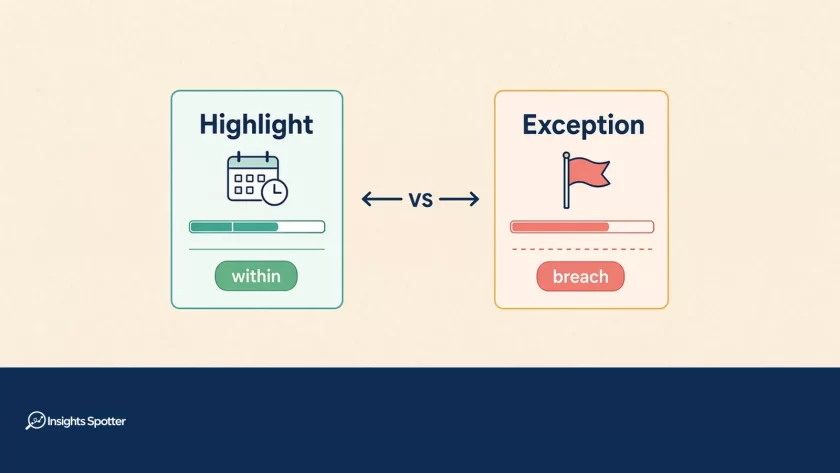
A Highlight Report keeps the board informed about stage progress between end-stage assessments, supporting management by exception. An Exception Report brings a forecast tolerance breach to the board for direction. You should not wait for the next reporting date to escalate it.
The highlight report template and PRINCE2 exception report template below turn that distinction into usable reporting shapes. They help answer three questions: what changed, where authority ends, and what decision is needed?
Definitions before the templates
Education note: All worked template sections, fictional figures and tolerance-flag tables below are InsightSpotter teaching aids for local adaptation. They are not official PeopleCert Product Descriptions or a certified form pack. Agree local formats and reporting arrangements through your Communication Management Approach.
Highlight Report: The project manager’s periodic summary of stage progress for the Project Board.
Exception: A forecast deviation beyond agreed tolerance limits.
Exception Report: The project manager’s escalation to the board explaining an actual or forecast stage/project tolerance breach and seeking direction.
Exception Plan: A replacement plan the board may request in response; it needs assessment and approval before replacing the affected plan.
Tolerance: The permitted variation around an agreed performance target before escalation to the next management level.
Manage by exception: Delegate authority within tolerances and escalate forecast departures beyond those limits.
Checkpoint Report: A time-driven report from team manager to project manager on work-package progress; an input to stage reporting.
As of October 2026, the official method name is PRINCE2 Project Management (Version 7), maintained by PeopleCert. “PRINCE2 7” remains useful search shorthand. PeopleCert’s Foundation overview describes seven principles, seven practices, seven processes and the integrated people element. Sustainability is the seventh performance target; the PRINCE2.com Version 7 overview explains the edition and naming changes. PRINCE2.com is operated by training provider ILX; PeopleCert maintains the method.
Seven performance targets: make the limits visible
A tolerance needs a measure, an agreed boundary and an authority level. “Budget looks tight” supplies none of those. Distinguish project limits from the stage limits delegated to the project manager and the relevant work-package limits agreed with team managers. Do not assume every target has an identical tolerance at every level.
InsightSpotter teaching table — fictional booking-trial limits and flags. These illustrate different measures, not recommended universal thresholds.
| Performance target | What the tolerance concerns | Example evidence and flag |
|---|---|---|
| Benefits | Permitted variation in expected or realised benefits | Expected monthly administration saving: 80 hours; minimum 70. Forecast 78: within project tolerance. |
| Cost | Permitted spending variation | Stage budget €40,000; upper limit €42,000. Forecast €41,800: within, approaching limit. |
| Time | Permitted early or late delivery | Stage target 13 November; latest permitted finish 17 November. Forecast 16 November: within, approaching limit. |
| Quality | Permitted variation from quality criteria | No critical acceptance defects; booking response at most two seconds. Current tested response 1.7 seconds; no critical failures: within. |
| Scope | Permitted variation in planned products | Booking, confirmation and audit export mandatory; reminder optional. All mandatory products forecast: within. |
| Sustainability | Limits on agreed sustainability measures | Trial travel ceiling 200 vehicle-km. Forecast 160: within. |
| Risk | Limits on aggregated risk exposure | Locally agreed aggregate exposure ceiling: Moderate. Current assessment Moderate: within, monitor. |
The figures make the boundary visible; the supporting evidence makes the flag credible. Record forecast date, source, owner and uncertainty. Benefits may be realised after delivery, so report their forecast against the relevant project/business-case target rather than pretending a weekly stage report measures realised benefits.
Use colour alongside those facts. InsightSpotter’s RAG status criteria connect reporting to management by exception: escalate when tolerances are forecast to break. An Amber warning can remain inside tolerance. A Red signal requires investigation, but colour alone does not establish which delegated tolerance has been breached.
Missing or stale required evidence means Not assessed, with an owner and deadline to resolve the gap. Keep unresolved adverse exceptions visible. A colour override does not close a failed acceptance check or authorise a new baseline.
Highlight report template: establish a reporting rhythm
The project manager writes for the Project Board at the agreed cadence. Weekly is a possible local choice, not a universal PRINCE2 rule. Agree frequency and content with the board, and revisit them when stage risk or decision needs change.
A useful Highlight gives the board enough context to retain control while leaving day-to-day delivery with the project manager. Build it from verified work-package reporting, product acceptance evidence, forecasts and current risk/issue records.
InsightSpotter teaching template — adapt these sections:
- Identity and period: project, stage, report date, period covered and baseline references.
- Progress against products: completed and accepted products, planned work unfinished, and corrective action taken.
- Tolerance position: actuals and forecasts against relevant stage and project limits, with evidence dates.
- Issues, risks and change requests: material movement, named owners, linked records and business-case implications.
- Next period: products and checks expected, dependencies, and any useful lesson affecting the plan.
- Board attention: a specific request, or an explicit statement that no exception decision is requested.
Worked Highlight excerpt: still within tolerance
Fictional teaching example — booking trial, stage 2, period 2–6 November 2026; issued 6 November.
“Booking and confirmation integration checks passed. Audit export remains planned for the next period. Stage spend to date is €28,000; the updated estimate at completion is €41,800 against the €42,000 upper limit. Stage finish is forecast for 16 November against the 17 November latest permitted finish. Overall delivery signal: Amber under our agreed local rules; no stage tolerance breach forecast.”
InsightSpotter teaching flags — evidence reviewed on 6 November:
| Target | Current position | Tolerance flag |
|---|---|---|
| Benefits | Project forecast: 78 hours saved monthly; minimum 70 | Within |
| Cost | Stage forecast €41,800; maximum €42,000 | Within; Amber warning |
| Time | Stage forecast 16 November; latest 17 November | Within; Amber warning |
| Quality | Executed checks pass; 1.7-second response; remaining checks planned and not yet due | Within on current evidence; acceptance still pending |
| Scope | All three mandatory products forecast | Within |
| Sustainability | Forecast trial travel 160 vehicle-km; maximum 200 | Within |
| Risk | Aggregate exposure Moderate; ceiling Moderate | Within; monitor |
“Supplier availability risk RSK-014 remains open, owned by Leo. Action ACT-021: Leo to confirm the remaining test slot by 9 November. No exception decision requested. If slot confirmation changes the stage forecast beyond tolerance, Nora will escalate immediately.”
The report is Amber because the margin is narrow. Calling it Green because the demo went well would hide that warning. Calling it an exception solely because it is Amber would confuse attention with authority.
PRINCE2 exception report template: turn a breach into a choice
An Exception Report is event-driven. A forecast breach is enough; actual spending or elapsed time need not have crossed the boundary yet.
The PeopleCert Foundation Quick Reference Guide, progress section, available on a training-provider host, distinguishes the escalation levels: a work-package exception goes to the project manager as an issue; a stage exception goes to the board; forecast project tolerance breaches require the board to refer the decision to the business layer. That may be corporate or programme management in your organisation.
The board cannot approve beyond its own delegated authority simply because a request arrives in a polished report. Nor should a project manager quietly enlarge the tolerance to restore Green.
InsightSpotter teaching template — adapt these sections:
- Exception and evidence: affected baseline, tolerance limit, actual position, forecast and evidence date.
- Cause and consequences: why the forecast changed; effects on products, business case, benefits and other targets.
- Options: feasible responses, costs, dates, scope/quality implications and remaining uncertainty.
- Recommendation: preferred response and why its trade-offs are acceptable.
- Decision request: decision owner, latest useful decision time, authority required and consequence of delay.
- Traceability: issue/risk IDs, supporting estimates and where the decision and actions will be recorded.
Worked Exception excerpt: the forecast crosses the boundary
Fictional teaching example — issued 9 November, following the Highlight above.
“EXC-002: the supplier has withdrawn the reserved test slot. Issue ISS-009, owned by Leo, records the confirmed loss. Current stage spend is €30,000, but the revised estimate at completion is €44,500. Forecast finish is 19 November. These exceed the €42,000 cost ceiling and 17 November latest finish. Direction is needed by 12:00 on 10 November to secure an alternative.”
InsightSpotter teaching flags — current forecast before a decision:
| Target | Revised position on 9 November | Tolerance flag |
|---|---|---|
| Benefits | Forecast 76 hours saved monthly; minimum 70 | Within project tolerance |
| Cost | €44,500 versus €42,000 ceiling | Forecast breach |
| Time | 19 November versus 17 November latest finish | Forecast breach |
| Quality | Prior checks remain valid; remaining checks rescheduled; criteria unchanged and forecast achievable | Within forecast; acceptance pending |
| Scope | Mandatory products retained | Within |
| Sustainability | Forecast travel 180 vehicle-km versus 200 ceiling | Within |
| Risk | Reassessed aggregate exposure Moderate, including remaining supplier uncertainty | Within; monitor |
“The later trial delays learning and narrows the benefit margin. The business case remains viable on current estimates, subject to confirming supplier capacity.”
InsightSpotter teaching options — estimates, not approved commitments:
| Option | Forecast and trade-off | Required direction |
|---|---|---|
| A: retain supplier | €44,500; finish 19 November; full scope and quality criteria retained | Consider revised stage limits within project authority, or escalate further |
| B: use alternative test support | €42,000; finish 17 November; mandatory scope retained, optional reminder deferred; capacity uncertain | Request an Exception Plan and confirm capacity before approval |
| C: stop the trial | Avoid further trial delivery commitments; assess closure costs and lost benefits | Direct closure assessment through the proper authority |
“Recommend B, conditional on capacity evidence. Request an Exception Plan showing remaining work, acceptance checks and updated forecasts. Project limits in this fictional case are €120,000 and 30 November; total project forecasts under A/B are €114,500/€112,000 and 27/25 November respectively. Check all project targets before authorising a response. If that check forecasts a project breach, refer it to the business layer.”
Requesting the plan does not approve it. If more information is needed, give that request an owner and deadline, and state interim spending/work limits. Until authorised otherwise, the original baseline and open exception remain visible.
Keep one evidence trail through the mini-case
Nora’s rhythm now has a purpose. On 6 November, the Highlight shows a narrow but credible margin. On 9 November, supplier confirmation changes the forecast and triggers EXC-002 immediately. The next Highlight references that exception and the response rather than concealing it inside another progress paragraph.
The RAID log template supplies the ownership discipline: choose one RAID expansion, give each row one named owner, and close against agreed evidence. Here, use Risks, Actions, Issues and Decisions. RSK-014 records the earlier uncertainty; ISS-009 records the realised supplier problem; ACT-021 records the follow-up. Do not close residual supplier risk merely because an issue now exists.
When the board decides, link DEC-006 to EXC-002, the selected option, conditions and subsequent approval evidence. Assign each implementation action to one person. Where formal PRINCE2 registers already exist, reference them rather than creating competing records.
PeopleCert’s co-author explanation of the Issues practice stresses that an issue does not automatically mean a change. Capture and assess the supplier problem before assuming which baseline needs alteration.
If your SteerCo fulfils the Project Board role, use a decision-first SteerCo agenda item: “Select the test-support response and direct preparation of the Exception Plan by 10 November.” Check its remit. A committee that only recommends expenditure cannot supply the final approval.
Reporting failures that break the rhythm
An Exception Report becomes an “angry Highlight” when it repeats bad news without options or a recommendation. A late escalation removes choices: yesterday’s avoidable delay becomes today’s unavoidable cost.
Other failures are quieter: Red without the breached limit; actual spend without a completion estimate; an exception without linked records; or a board hearing nothing between stages because everyone assumes management by exception means no reporting.
Treat the next report as a decision aid. Keep the warning, supporting evidence and requested response together. Report uncertainty explicitly, and retain open failures until closure evidence supports resolution.
Before sending: eight checks
- Cadence: Are the Highlight frequency, audience and content agreed?
- Limits: Are baseline versions, authority levels and all seven target positions clear?
- Forecast: Have you compared expected completion with tolerance, alongside actuals?
- Evidence: Are sources current, gaps explicit and unresolved adverse exceptions retained?
- Choice: Does an Exception explain options, impacts and a recommendation?
- Authority: Can this recipient decide, or must the board escalate further?
- Ownership: Do RAID/register references identify owners, actions and closure evidence?
- Ask: Is the decision deadline explicit, and does the RAG narrative match the tolerance story?
When a lighter report is enough
A tiny internal project with continuous board contact may need a short agreed report. An organisation’s existing tool can supply the reporting view if it carries the necessary evidence and decisions. Avoid maintaining another document solely to repeat it.
For Scrum teams, leave ticket detail and sprint discussion in the delivery tools. Translate their implications into products, stage forecasts and governance choices. Highlight Reports do not replace Checkpoint Reports, End Stage Reports or a board’s supporting decision pack.
When an exception is already known, reference its current decision status in routine reporting. Rewriting it twice without an ask adds no control. Nora’s improved report earns its space when the board can see the remaining margin, recognise a forecast breach and act while useful options remain.